2007-01-29
Myths about physical seals

2006-11-15
That Monaghan car crash in... empty
On Saturday 2006-10-21, two cars were crashed into one another in Co. Monaghan. Five people died as a direct result. This unusually-bad fatal crash provoked much comment about Irish driving standards, and the peculiar reticence of reporting of car crashes in the Irish media.
Sarah Carey wrote about it. I don't know what she wrote, because she gave in to comments (reported by fatmammycat and irisheyes) that she interpreted as personal threats.
The reporting of motor vehicle crime by Irish media is uniquely euphemistic.
Drivers do not swerve off the road — instead, cars leave the road
.
Drivers do not crash their cars — the cars themselves become involved in a collision
.
In particular, drivers do not kill or cause serious injury — instead, the victims are reported to have lost their lives following an accident
.
When the driver in question survives, this coyness in reporting could be put down to fear of litigation from a driver who escapes conviction. It's more baffling when the driver has killed himself or herself, and isn't around to sue. We then hear nothing but expressions of sympathy for the families (heartfelt but irrelevant to the road-safety issue) and some frustrating generalizations about young drivers, speeding, and drink-driving.
If reporting of aviation disasters was as circumspect as reporting of motoring disasters, aviation would be as dangerous as Irish roads. Aviation safety is hugely improved by the policy of openness in investigation of accidents. Conversely, road safety is damaged by the policy of reporting car crimes as if they were tragic accidents, and not crimes.
Sadly, there is no possibility that the traffic law will be enforced, because there's an election coming, and too many people want to commit car crimes in this country. They have convinced themselves through a process of cognitive dissonance that the traffic laws they break are unjust, and that their crimes are not actually wrong. In fact, they have simply become used to doing what other drivers have bullied them into doing — driving faster and everywhere. This is a battle that political parties dare not fight, when there are so many people who view driving home from the pub as a basic civil right, and Ministers of the Government are happy to drink and drive, and to drive (or be driven) at illegal speeds.
If we can't even talk about the personal, criminal responsibility of drivers who kill, how can we possibly hope to reduce dangerous driving in our country?
Sampler's Culchie Control Platform
Hallowe'en Horror
2006-09-18
Talk Like A Pirate Day
2006-09-09
Tom Limoncelli's Time Management for System Administrators
2006-09-05
Just Try Voting Here: 11 of America's Worst Places to Cast a Ballot (or Try)
A wonderfully shocking summary of the biggest things wrong with the USA's electoral system, which is right up there with Zimbabwe's. The problems are, briefly:
- Citizens can't vote without a special token issued by the state (normal ID is not enough)
- Electronic voting machines screw up all the time with huge effects on count results
- Citizens in poorer neighbourhoods wait hours in line to vote
- No training for poll workers means no voting until afternoon
- Good old dirty tricks are used to mislead voters and disrupt campaigning
- Gerrymandering is now a widespread craft
- Citizens convicted of felonies are not told if or when their voting rights are restored
- The careful selection of pessimal electoral schemes is used as a creative means of minimizing representation for minority groups.
- Citizens away at university are simply denied the right to vote
- Voter registration forms are selectively "lost"
- It has become acceptable for election supervisors to abuse their power to favour their party
Dónal's Stag Party
My good friend Dónal had a stag weekend recently, and people took photos of the respectable bits:
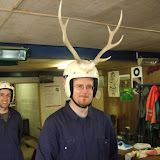
Here's the video that Brian shot at the same time:
Gideon announced he'll be posting his photos of the event as soon as he JPEGizes them this week.
2006-09-04
2006-08-22
Dan's Quick Guide to Memory Effect, You Idiots
2006-08-20
Click fraud
2006-08-15

2006-07-31
2006-05-19


2006-05-13
2006-05-11
Trends
My employer's new Trends service is oddly addictive. Here are some of my searches which got satisfying results:
- cheap, fast, good
- beatles, jesus
- mercurial, bitkeeper (odd, this one seems to cut off in mid-2005)
- left, right
- clue, aol
- cthulhu, condoleezza
Career Development Plan
A friend emailed me something I wrote long ago and have since completely forgotten. I think I was quite witty back then. Well, I laughed today at what I wrote ten years ago:
Michele Shaw writes:
>
> ** Create a career development plan
>This is a concept which has always baffled me.
CAREER DEVELOPMENT PLAN V1.0
ABSTRACT.
This document details the future as it applies to me, paying particular attention to my career preferences. In the course of this, accurate predictions will be made of technological advances, market forces, personal life developments, revelation, disillusion, and of course my future personal preferences. The result will be a wholly useful and informative opus, whose scope is not limited in any practical way, and which is neither a success placebo nor a daydreaming exercise designed to impart artificial job satisfaction.
1. Introduction
Many things affect the future career of anyone in a rapidly changing industry, but fortunately most of them are amenable to management analysis born of the fast-moving hamburger approximation and retail industry, and so the problem of the directivity of time is not, empirically, an obstacle to such analysis. Accordingly, the future is laid out in the following sections by date.
2. Year 1998
In the late part of the year, political mistakes by the heads of department will allow me to lead a coup and restructure the department, leaving me as nominal second-in-command, behind an ineffectual cannonfodder manager who knows discretion and little else.
3. Year 1999
The release of the hitherto-secret GNU automatic program-verification module for libbfd leaves the software industry stunned as it detects and flags bug after bug in binary code worldwide. Salaries fall as IT orgs and sub-orgs shed staff like woolly coats in July. I move into management of project integration at this point.
4. Year 2000
Microsoft's widespread and now GNU-debugged software runs slowly on intel machines worldwide, and they lever their monopoly for all it's worth. The collapse of the world's economy in January impels thousands of crippled businesses to switch to Microsoft products, because, ironically, they work better than the other stuff, and they're Microsoft compatible. I become a system developer at Microsoft, working on parallelising BFD so that the incredibly slow software can be stretched by throwing it at more hardware.
5. Year 2001
U.S. DoD switches its systems over to Microsoft Dimensions (the successor to Windows NT, is byte-compiled, has special instruction codes for load-low-low-longword, load-high-low-longword, load-low-high-longword, and load-high-high-longword to perform 128-bit computing). A synchronisation bug in BFD causes global eschaton.
6. Conclusions
I shall not invest stock, save money, or maintain a 401(k) plan.
7. Acknowledgements
I could not have completed this plan without the aid of Cassandra Tetragrammaton, one of HR's many talented omniscient career resolution consultants. Although she is on catatonic depression leave at the moment, I sincerely hope she will return in time to see the realisation and success of the plan she has helped me compile.
--adrian.
We are Chicken of Borg. You will be assimilated and... SQUAWK!